A day rate becomes a job price the moment you know how many days the job is.
At the £200 decorator benchmark, a living room runs £400 to £800 in labour, because the job itself runs 2 to 4 days.
Neither pricing method is cheaper by default.
What changes is who carries the risk of the job running long: a day rate puts it on the customer, and a fixed price puts it on the tradesperson, who then has to price for carrying it.
Almost every argument about which way to price is an argument about that second number. It is the one nobody has.
How the sum comes out
The £200 decorator benchmark multiplied by job lengths reported by a named professional decorator.
Both inputs are sourced on their own pages.
The money column is our arithmetic.
| Job | Days | Labour at £200 a day | Uncertainty |
|---|---|---|---|
| Box room or single bedroom | 1 to 2 days | £200 to £400 | £200 |
| Living room | 2 to 4 days | £400 to £800 | £400 |
| Hall, stairs and landing | 3.5 to 7 days | £700 to £1,400 | £700 |
| Three bed house, full interior | 1 to 2+ weeks | £1,400 to £2,800 | £1,400 |
Your next step
You have priced a job, so the next step is checking that the price pays your day rate.
The Rate Sorted calculator takes the quote apart line by line on your own figures and shows the margin left on the job.
What the two prices buy
That last column is the whole argument. Which pricing method you use decides who carries it.
On a day rate
The customer carries the overrun.
If the living room runs to the long end of its range, they pay for every extra day.
What they get in exchange is that they never pay for a risk that did not happen. A job that finishes early is simply fewer days.
On a fixed price
The tradesperson carries it, and has to price for carrying it.
A quote that has to cover 4 days cannot be priced as though it were 2. Whatever the job turns out to be.
What the customer gets for that is a number that cannot move.
Over enough jobs the two methods settle to similar money. What they price differently is who pays when one job is not typical.
How to weigh the two, in three steps
- 01Ask whether the job length is knownFor decorating it is published, in the table above, so the sum can be done.
- 02Decide who carries the overrunA day rate leaves the overrun with the customer. A fixed price moves it to the trade, and the quote grows to cover it.
- 03Do the sum both waysPrice the job at the short end and the long end of its range. The distance between the two totals is the risk you are pricing.
Not a recommendation
This site does not say which of the two you should use, because no evidence it holds would support saying it.
The 7 hour working day is our assumption, not a published figure.
We use it because tradespeople on MoneySavingExpert report decorator days of roughly 8.30am to 3.30pm.
How two towns price the same job
The day rate half of the sum moves with where the work is, so the job price does too.
Both towns below are modelled on earnings data from the ONS and prices per the UK House Price Index, and the job length is held the same in both.
So the gap between the two cards is the location effect on its own.
Every other input is deliberately unchanged.
Guildford, the dearest of the 30
£470 to £940
A living room at £235 a day, 2 to 4 days.
Sunderland, the cheapest
£320 to £640
The same job at £160 a day, on the same published durations.
The gap between those two towns for one living room is £300 at the long end, on labour alone.
What nobody publishes
Two things this page would need to go further, and neither exists as a sourced UK figure.
How long bad walls take
There is no published UK figure for how much longer heavy filling takes than sound walls.
The data does not exist.
So this page publishes no prep multiplier table, and will not invent one to fill the space where a published one would sit.
So the day ranges above are the honest width of the answer. Narrowing them would mean publishing a number no UK source stands behind.
How the other trades price
Sourced durations on this site cover decorating, plastering and tiling.
2 more guides print how long one named job takes: rewiring a house and fitting a boiler.
The other 12 trades have a benchmark and a 30 town table, and no published job length at all.
Multiplying a rate by a duration nobody publishes would produce a confident number with nothing behind it. So this page does not.
The rate half of the sum is sourced on the decorator page; the day counts come from Decorator's Forum UK and the labour constants published by Methvin.
Heads up
Rate estimates blend the national decorator day rate benchmark, published against the spread named UK trade price guides print, with official ONS regional earnings and local house price data.
Figures are modelled estimates for guidance, not quotes.
Sources: ONS ASHE 2025, UK House Price Index April 2026.
Common questions
The same answers the structured data on this page gives a search engine, word for word.
Is it cheaper to pay a decorator by the day or for the whole job?
Neither is cheaper by default.
Anyone who tells you otherwise is guessing.
They differ in who carries the risk of the job running long.
On a day rate the person paying carries it; on a fixed price the person working carries it, and prices for it.
The size of that risk is the width of the range: a living room runs 2 to 4 days on sourced figures, so at the £200 benchmark the same job is £400 or £800 depending on how it goes.
How do I turn a day rate into a price for my job?
Multiply the day rate by how many days the work takes.
That is the whole calculation, and the second number is the one most people do not have.
This site publishes both for decorating: a £200 national benchmark and durations from a named professional decorator, checked 13 July 2026.
A 7 hour working day is our assumption and is disclosed as one, so a quote built on a longer or shorter day will not match.
Why is the range so wide?
There is no published UK figure for how much longer heavy filling takes than sound walls.
The data does not exist.
So this page publishes no prep multiplier table, and will not invent one to fill the space where a published one would sit.
That is why the widest case here, a three bed house, full interior, spans £1,400 of labour at one benchmark rate.
Robin Gofton, professional decorator, Decorator's Forum UK, reports jobs where two weeks of work end with the walls painted on the final day.
Does this work for trades other than decorating?
The sum on this page is worked for decorating.
The arithmetic needs a published duration as well as a published rate, and durations here exist for decorating, plastering and tiling.
2 more guides print how long one named job takes: rewiring a house and fitting a boiler.
The other 12 trades have a benchmark and a 30 town table, and no sourced job length, so multiplying them would mean inventing the second number.
Take this working
Every money figure on this page is our own arithmetic, a published day rate multiplied by a published job duration, and it is free to reproduce with attribution provided the working is described that way rather than as a price anybody has quoted.
The pricing card carries the worked comparison, and the link goes to this page.
<a href="https://thedayrate.co.uk/day-rate-or-price-per-job/"><img src="https://thedayrate.co.uk/og/day-rate-or-price-per-job.png" alt="Day rate or price per job, worked from UK rates and durations, from The Day Rate Report" width="1200" height="630"></a>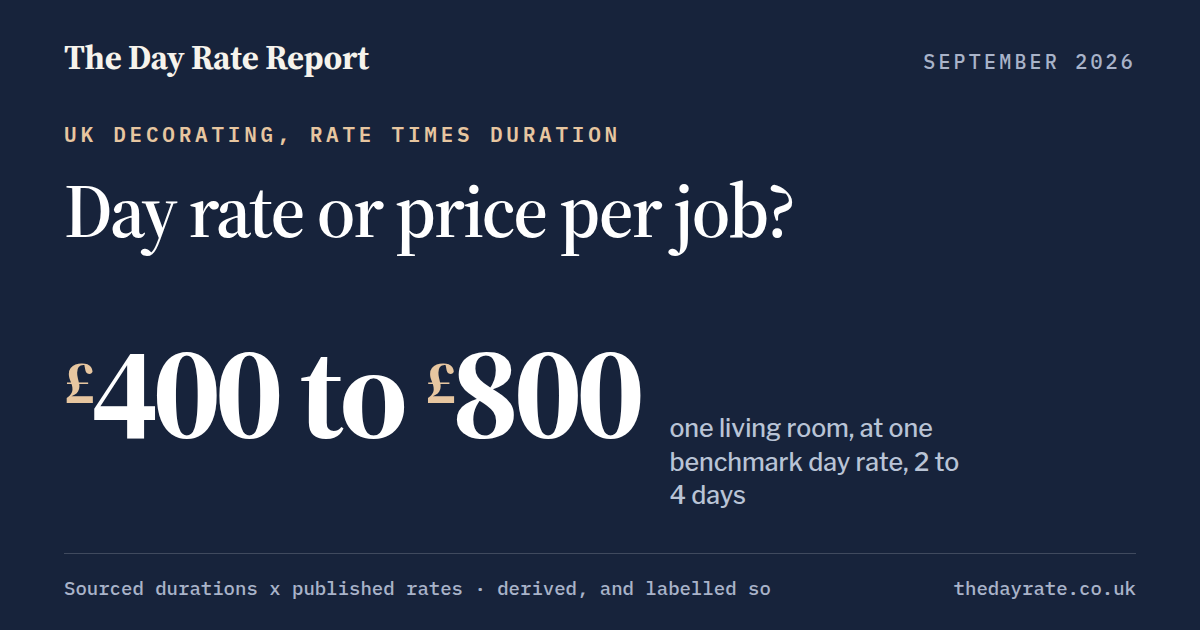
The worked sums on this page are free to reproduce, ours and labelled as ours, and a credit with a link back is all we ask, under CC BY 4.0.