At the fast rate
7.8 h
1.1 days on the tools.
Guide · plastering · rates sourced 18 August 2026
1.1 to 1.7 days
to skim 35 square metres of wall and a 16 square metre ceiling, which is our arithmetic on the fast and slow published rates rather than a reported job.
Plastering has a published speed, and it is three speeds rather than one.
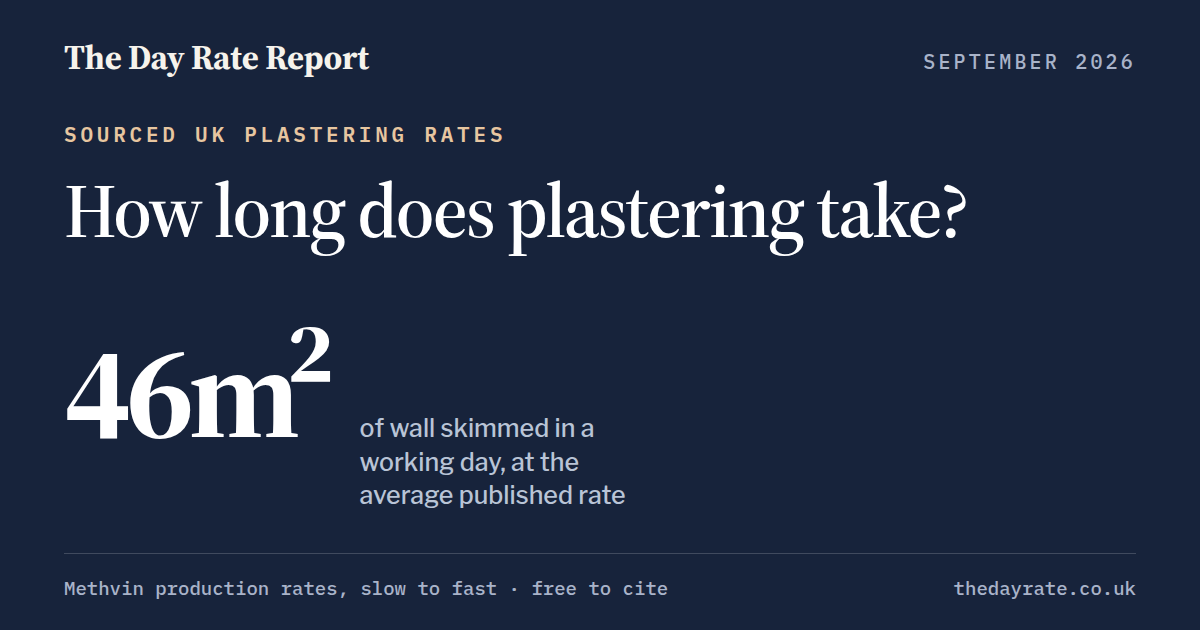
A plasterer skims about 46 square metres of wall in a working day at the average published rate, or about 22 square metres of ceiling.
Skimming a 4 metre by 4 metre room works out at 7.8 to 11.7 hours, which is 1.1 to 1.7 days.
That is the plaster going on, and not the time it needs to dry.
The gap between the slow and the fast rate is the honest answer to how long a job takes.
Square metres an hour, data from Methvin plastering production rates exactly as printed, with the last column ours: the average rate multiplied by an assumed 7 hour day.
| Task | Slow | Average | Fast | Per day |
|---|---|---|---|---|
| Skimming, internal walls under 2.5 m | 6.1 | 6.7 | 7.3 | 46 m² |
| Skimming, internal walls over 2.5 m | 5.5 | 6.1 | 6.7 | 42 m² |
| Ceilings, topcoat skimming | 2.7 | 3.2 | 5.4 | 22 m² |
| Ceilings, one bonding coat and one skim | 1.1 | 1.7 | 2.4 | 11 m² |
| Browning undercoat, walls under 2.5 m | 2.2 | 2.8 | 3.1 | 19 m² |
| Browning undercoat, walls over 2.5 m | 2.1 | 2.6 | 2.8 | 18 m² |
| Plasterboard to ceilings | 3.2 | 4.5 | 5.5 | 31 m² |
Why three columns and not one
Methvin publishes a slow, an average and a fast rate for every task on the register, and that spread is published rather than modelled, so it is shown here as three columns instead of being averaged away into one figure.
The 7 hour working day is ours, not the register's.
The decorating guide assumes the same one, so a plastering day and a decorating day on this site are the same length and the two pages can be read straight against each other.
Your next step
You have the browning and skimming hours, so the next step is the plastering day rate they get multiplied by.
The Rate Sorted calculator opens on plasterer, builds that rate from your own costs and carries it into a quote you can send.
The same room the decorating guide works. That is 35 square metres of wall and 16 of ceiling, skim coat over sound surfaces, so the two pages can be read straight against each other.
At the fast rate
7.8 h
1.1 days on the tools.
At the average rate
10.2 h
1.5 days on the tools.
At the slow rate
11.7 h
1.7 days on the tools.
Read the three figures as a published range, never as a target.
The fast rate is the fast end of the register, not a rushed job, and the slow rate is still a professional at work.
All three are hours with the plaster going on: setting up, mixing, protecting the room and clearing away sit on top of them, and none of it says when the wall is ready to paint.
What that figure is and is not
It is arithmetic on the published plastering rates, not a reported job.
It is also time with the plaster going on, and not time until the room can be painted.
Type a town and land on what these job lengths come to at that town's own plasterer rate.
All 30 towns, by regionThe heavier work is measured the other way up. According to the same register it is published in hours per square metre rather than square metres per hour, with a labourer column standing beside the tradesman's.
| Item | Tradesman | Labourer |
|---|---|---|
| Hardwall plaster, two coats, 16 mm, walls | 0.42 | 0.18 |
| Hardwall plaster, two coats, soffits | 0.50 | 0.20 |
| Hardwall plaster, columns and beams | 0.55 | 0.25 |
| Skim coat hardwall plaster on soffits | 0.22 | 0.08 |
| Cement render, one coat, 13 mm, walls | 0.25 | 0.11 |
| Cement render, soffits | 0.28 | 0.11 |
| Cement render, columns and beams | 0.42 | 0.18 |
| Render for wall tiling, cement and sand, one coat 13 mm | 0.20 | 0.10 |
Read the second column carefully
The labourer column is a second person working at the same time, not extra hours for the plasterer.
Take a job at 0.42 tradesman hours and 0.18 labourer hours per square metre.
That is 0.42 hours of site time with two people on it.
It is never 0.60.
Both are things a reader genuinely wants. Neither exists as a sourced UK figure in this repo, so neither is filled in.
How long before you can paint it
This register says nothing about how long plaster takes to dry before it can be painted, and this site holds no sourced UK drying figure for it either.
A fresh skim is not ready for a decorator the same day.
How much longer it needs, this page will not invent.
The decorating guide can publish manufacturer recoat windows for paint because the paint makers publish them.
Nobody publishes the plaster equivalent here.
What real jobs run to
The decorating guide can put published labour constants beside real job durations reported by a named professional decorator.
No plastering equivalent exists, so every day figure on this page is arithmetic on the constants alone, which is what the work should take rather than what jobs are reported to take.
The same answers the structured data on this page gives a search engine, word for word.
A skim over sound walls and ceiling in a 4 metre by 4 metre room works out at 7.8 to 11.7 hours.
That is 1.1 to 1.7 days on a 7 hour day.
That is our arithmetic on published rates, not a job length anyone has reported.
It covers getting the plaster on.
It does not cover waiting for it to dry.
About 46 square metres of wall at the average published rate, in a room under 2.5 metres high.
A ceiling is much slower.
Reckon on about 22 square metres of topcoat skim in the same day, because it is all worked overhead.
The slowest job on the register is ceilings, one bonding coat and one skim, at about 11 square metres a day.
This register says nothing about how long plaster takes to dry before it can be painted, and this site holds no sourced UK drying figure for it either.
A fresh skim is not ready for a decorator the same day.
How much longer it needs, this page will not invent.
Methvin publishes a slow, an average and a fast rate for every task on the register, and that spread is published rather than modelled, so it is shown here as three columns instead of being averaged away into one figure.
On the worked room that spread is the difference between 7.8 hours and 11.7 hours for the same job.
Free to cite and free to download, with the source named and dated on every row.
The plastering card carries the production rate spread, and the link goes to this guide.
<a href="https://thedayrate.co.uk/plasterer/how-long-to-plaster-a-room/"><img src="https://thedayrate.co.uk/og/how-long-does-plastering-take.png" alt="How long plastering takes, from sourced UK production rates, The Day Rate Report" width="1200" height="630"></a>The 7 production rates and 8 man hour norms here are free to use in an article or a fact check, and a credit with a link back is all we ask, under CC BY 4.0.
Production rates and man-hour norms are shown exactly as Methvin publishes them.
Hours and days are derived: the published rate divided into the area, on an assumed 7 hour working day.
Where a plastering figure does not exist, this page says so.