Widest town gap
£105
a day between Guildford and Sunderland, for electricians.
Guide · 17 trades · benchmarks checked 30 September 2026
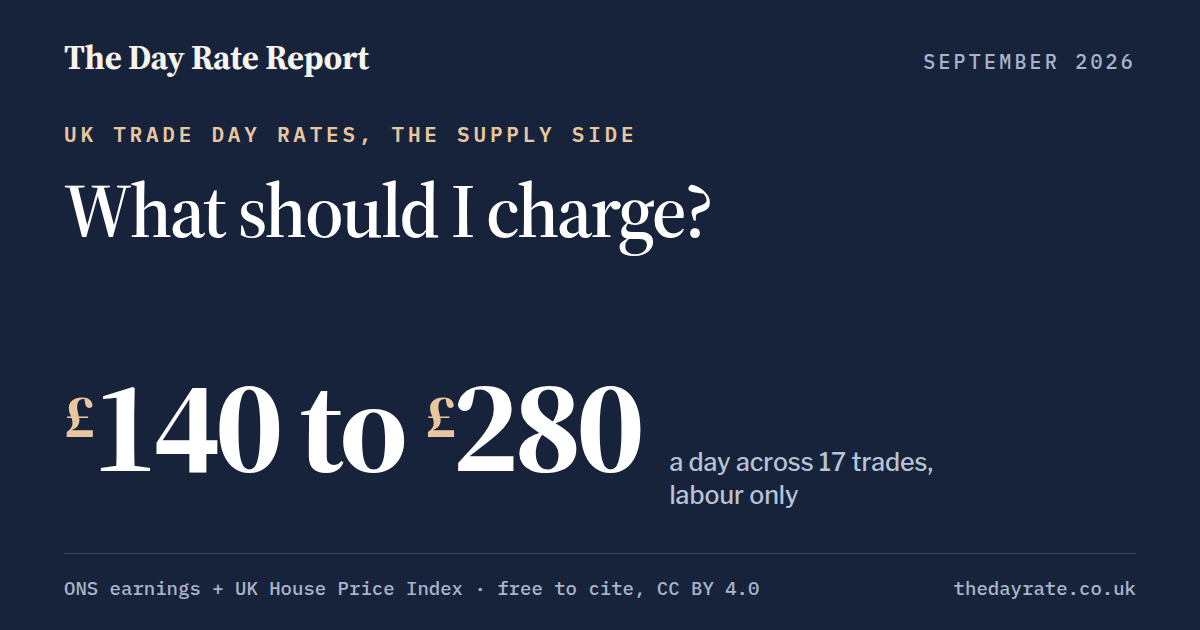
£140 to £280
a day across the 17 trades on this site, general labourers at the bottom and electricians at the top, labour only.
This page will not tell you what to charge.
It tells you what the work is going for.
UK trade day rates on this site run from £140 a day for general labourers to £280 for electricians, labour only, before materials and VAT.
Where you work moves that figure by up to £105 a day.
Those are benchmarks for what the market pays, not a rate anyone should copy.
Same data, turned round. Everything below is what the rest of this site publishes for the person paying the bill, read instead from the side of the person sending it.
Three columns. The national benchmark, the range published according to named UK price guides beside it, and how far that figure moves once you account for where the work is.
| Trade | Benchmark | What the guides publish | Across 30 towns |
|---|---|---|---|
| Electrician | £280 | £150 to £500 | £224 to £329 |
| Plumber | £270 | £150 to £480 | £216 to £318 |
| Bricklayer | £260 | £120 to £320 | £208 to £306 |
| Gas and Heating Engineer | £259 | £180 to £480 | £207 to £305 |
| General Builder | £253 | £133 to £400 | £202 to £298 |
| Carpenter and joiner | £240 | £130 to £360 | £192 to £282 |
| Roofer | £239 | £150 to £360 | £191 to £281 |
| Plasterer | £230 | £110 to £400 | £184 to £271 |
| Tiler | £229 | £140 to £350 | £183 to £269 |
| Drainage Engineer | £225 | £215 to £460 | £180 to £265 |
| Decorative Plasterer | £225 | £150 to £800 | £180 to £265 |
| Groundworker | £213 | no guide publishes one | £170 to £251 |
| Painter and decorator | £200 | £120 to £400 | £160 to £235 |
| Handyman | £188 | £90 to £280 | £150 to £221 |
| Cladding Installer | £175 | £100 to £300 | £140 to £206 |
| Suspended Ceiling Installer | £175 | £150 to £200 | £140 to £206 |
| General Labourer | £140 | £100 to £360 | £112 to £165 |
The guides named across that middle column are Checkatrade, MyBuilder, HaMuch, CostEstimator, MyJobQuote, PriceYourJob, HomeHow and ConcreteMath, each checked on the date its trade page records.
Your next step
Now hold your own number against these 17.
Choose your trade in the Rate Sorted calculator, give it the take home you want and what the van and insurance cost, and your rate comes back beside the same figures.
The most useful thing on the table above is how wide some of those middle columns are.
The guides disagree with each other
Decorative Plasterer is the widest case: named guides publish £150 to £800 a day, a £650 range for the same trade.
That is not one guide being wrong.
It is what happens when different sites survey different work in different parts of the country.
So a reader who finds one figure online and treats it as the going rate has read a fraction of the evidence.
Where the ends of a range come from
A low is usually the simplest work in the cheapest area, and a high is specialist work where labour is scarce.
Neither end is a floor or a ceiling on what anyone can charge.
This site has no evidence about which end of that range a given job sits at, and it does not guess: what it can tell you is where the ends are and who published them.
One trade has no comparable guide figure published anywhere.
Those pages state that plainly instead of showing a spread.
One method
Each benchmark is checked against the day rates UK trade price guides publish, and every trade page shows that published spread with the date it was checked.
One method, every trade.
We publish the benchmark and the spread beside it, and we do not claim the benchmark was derived from those guides.
Every benchmark on this site is spread across 30 towns using earnings data from the ONS Annual Survey of Hours and Earnings and prices per the UK House Price Index, and that spread is the size of the location effect.
Widest town gap
£105
a day between Guildford and Sunderland, for electricians.
Painter and decorator premium
47%
between the dearest and cheapest of the 30 towns, for the trade this site anchors on.
The pay input behind it
£766.60
UK median weekly full time pay, the national figure each region is measured against.
Open your own town to see all 17 trades priced on it, or a trade page for the full 30 town table behind its benchmark.
The same model runs on every trade, so the location effect you see for your trade is measured on the same inputs as every other, not guessed trade by trade.
London is not one of the 30 towns, so what the guides publish for London has a page of its own.
The questions a rate alone cannot answer, and which of them this site has no figure for.
Not what you take home
A day rate is what a job is billed at.
That is before materials, before VAT, and before any of the cost of running a business.
This site publishes no tax content and no take home arithmetic, because it holds no sourced figure for either.
Not a rate to copy
A benchmark describes a market.
It says nothing about your experience, your overheads or how busy you are.
What it is good for is checking whether a figure you already have in mind is inside the range the market is paying.
Heads up
Rate estimates blend the national decorator day rate benchmark, published against the spread named UK trade price guides print, with official ONS regional earnings and local house price data.
Figures are modelled estimates for guidance, not quotes.
Sources: ONS ASHE 2025, UK House Price Index April 2026.
The same answers the structured data on this page gives a search engine, word for word.
The benchmarks on this site run from £140 a day for general labourers to £280 for electricians, labour only, before materials and VAT.
Those are what the market pays, not a recommendation: this site reports rates and does not set them.
Your own figure also depends on where you work, which moves decorator rates by £75 a day across the 30 modelled towns.
Because the guides genuinely disagree.
The widest case here is decorative plasterer, where named UK price guides publish anything from £150 to £800 a day, a £650 range for the same job.
A single average hides that.
This site publishes the spread beside the benchmark so the disagreement is visible rather than smoothed away.
The market already does.
The widest town gap of the 17 trades is electrician, at £329 in Guildford against £224 in Sunderland.
For decorators that gap is 47 per cent between the dearest and cheapest of the 30 towns.
The modelling behind those figures is regional earnings and local house prices, both official and both named on the methodology page.
No, and it will not.
It publishes what UK price guides and a rate model say the market pays, so a figure can be checked rather than guessed at.
It carries no tax content of any kind, because no figure on this site sources one.
Every benchmark and spread on this page is free to reproduce with attribution. Each trade's own page carries its CSV.
The benchmarks card names the figure a tradesperson is checking, and the link goes to this page.
<a href="https://thedayrate.co.uk/what-should-i-charge/"><img src="https://thedayrate.co.uk/og/what-should-i-charge.png" alt="What to charge: 17 UK trade benchmarks, from The Day Rate Report" width="1200" height="630"></a>The 17 benchmarks on this page are free to quote in an article or a fact check, and a credit with a link back is all we ask, under CC BY 4.0.